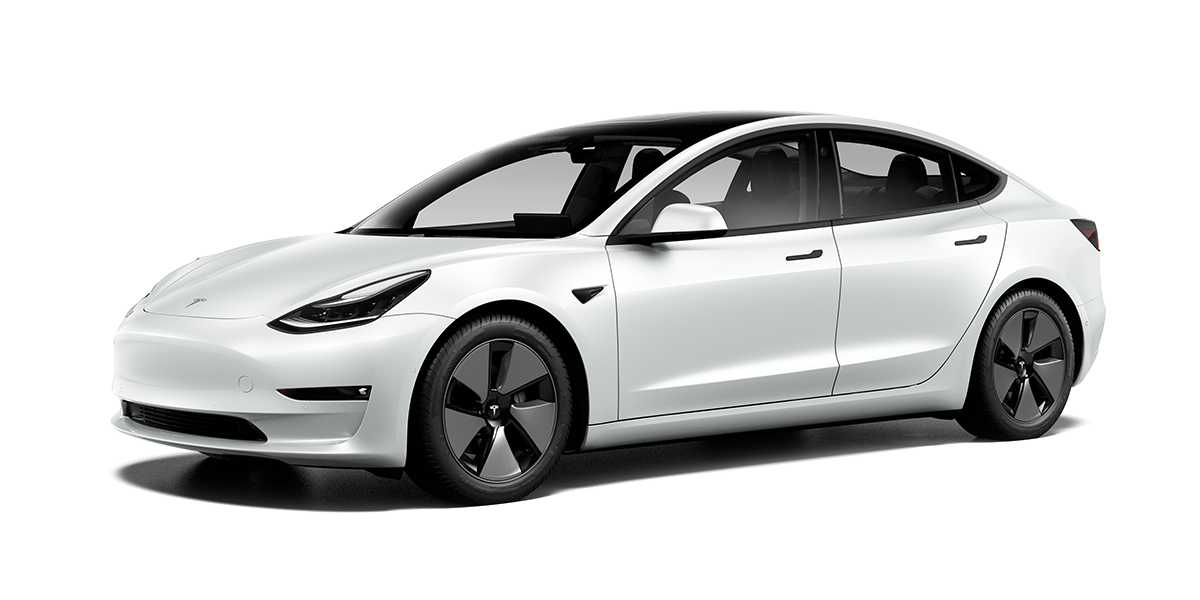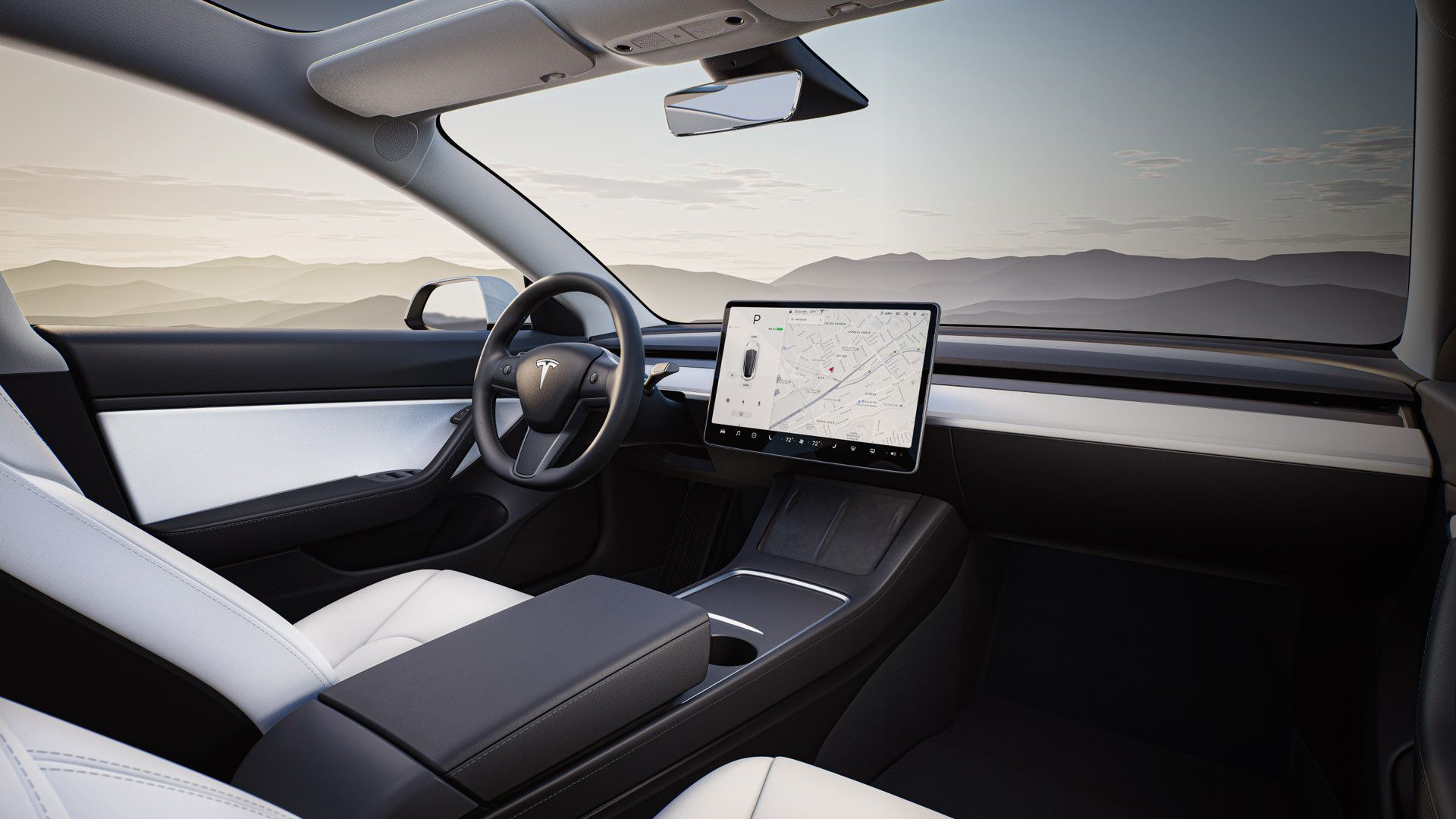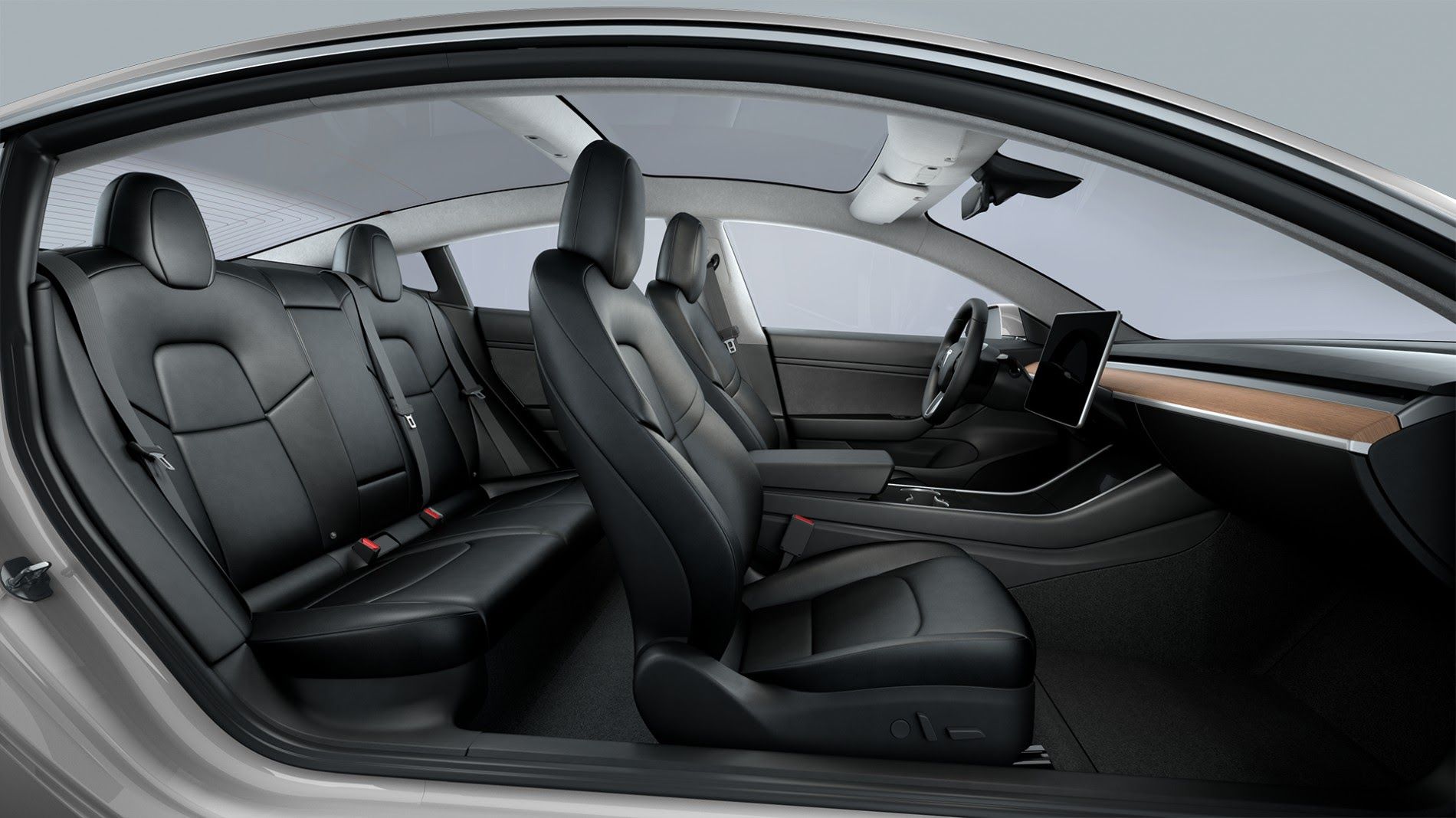
Tesla Model 3 electric car

Tesla Model 3

Technical data, ranges, variants, prices and news on the Tesla Model 3.

RANGE (WLTP)up to 750 km
0–100 KM/Hfrom 3.1 s
PRICEfrom €36,990
RWDLong Range RWDLong Range AWDPerformance
DrivetrainRear-wheel driveRear-wheel driveAll-wheel driveAll-wheel drive
Range (WLTP)534 km750 km660 km571 km
0–100 km/h6.2 s5.2 s4.4 s3.1 s
Fast charge (15 min, Supercharger)up to 270 kmup to 311 kmup to 275 kmup to 237 km
Price (from)€36,990€44,990€49,990€58,490

Figures as of 2025 (Model 3 "Highland", German market). Prices and values may change – please verify against tesla.com.

View equipment & comparison

Source: tesla.com – Model 3 („Modelle vergleichen“)

Sustainability Ranking of EV Makers

Lead the Charge assesses automakers' supply chains on climate, environment and human rights (2026 scorecard) — total score in percent.

Tesla49 %
Ford45 %
Volvo44 %
Mercedes-Benz41 %
Volkswagen39 %
BMW34 %
Renault31 %
Geely27 %
Hyundai23 %
General Motors22 %
Kia21 %
Stellantis21 %
Nissan15 %

Source: Lead the Charge – Scorecard (2026)

Human Rights Ranking of EV Makers

Amnesty International assesses EV makers' human rights due diligence in battery supply chains (“Recharge for Rights”, October 2024) — maximum 90 points.

Mercedes-Benz51 / 90
Tesla49 / 90
Stellantis42 / 90
BMW41 / 90
Ford41 / 90
VW Group41 / 90
General Motors32 / 90
Renault27 / 90
Geely Auto22 / 90
Nissan22 / 90
Hyundai21 / 90
Mitsubishi Motors13 / 90
BYD11 / 90

Source: Amnesty International – „Recharge for Rights“ (10/2024)

Safety Ratings

Tesla Model 3 (Highland), Euro NCAP 2025 — overall rating 5 out of 5 stars under the stricter protocol in force since 2022. The percentages are therefore not directly comparable with the 2019 test.

Best in Class 2025 – Large Family Car
5 / 5 · Euro NCAP 2025
Adult occupant90% (37,8 / 42)
Child occupant93% (46,5 / 50)
Vulnerable road users89% (56,2 / 63)
Safety assist87% (34,8 / 40)

Detailed findings from the test report (2025)

  • Side impact & pole test: maximum points, good protection of all critical body areas
  • Full-width frontal impact: chest protection in the rear seat rated only “marginal”
  • Child safety: maximum points in frontal and side tests; child-presence detection as standard
  • AEB for pedestrians/cyclists: rated “good” in all scenarios; active bonnet as standard
  • Known weakness: as in 2019, weaker pedestrian protection at the stiff A-pillars and windscreen frame
ANCAP (2025, Highland):5 stars
Green NCAP (2024):5 stars · 20.8 kWh/100 km
Euro NCAP (2019, 1st generation):5 stars (96/86/74/94%; rating expired 01/2026)
NHTSA (2019):5 stars in all categories
IIHS:“Good” in all crashworthiness tests

Close competitors in the Euro NCAP comparison

BMW i4 (2022):4 stars (87/87/71/64%)
Polestar 2 (2021):5 stars (93/89/80/83%)

Source: Euro NCAP – Tesla Model 3 (2025)

Good to know

Charging at home

Charging at home

An electric car is most beneficial ecologically when charged with electricity from renewable sources. With electricity from conventional power plants the advantages are smaller. At home the Model 3 can easily be charged from a standard household socket.

Rare earths

Rare earths

Tesla states that it does not use rare earths from conflict regions and has the origin and working conditions certified (conflict minerals policy).

Source: Tesla Conflict Minerals Report

Supercharger

Supercharger

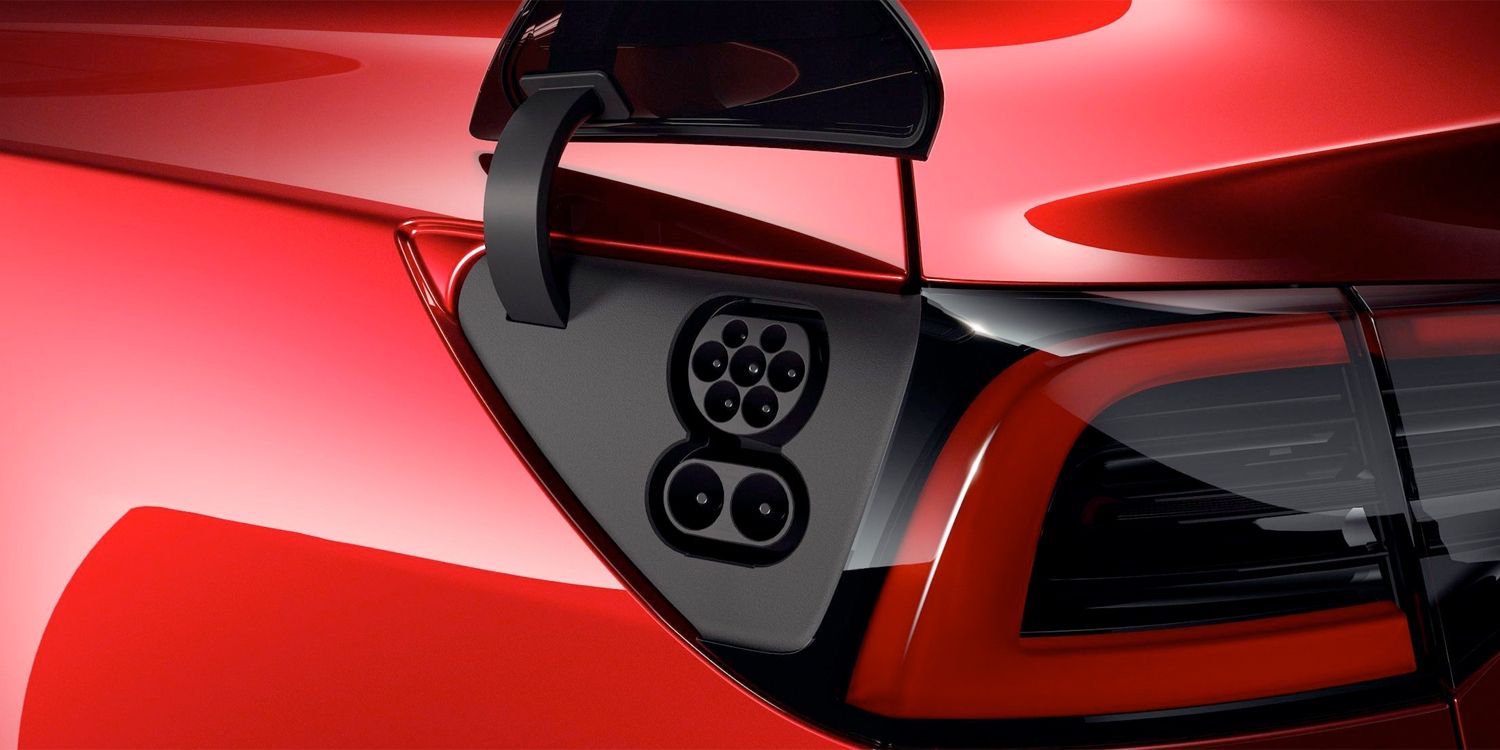
In Europe the Model 3 uses the CCS charging standard and can therefore use other fast-charging stations (e.g. Ionity) in addition to the Tesla Supercharger network. At a Supercharger it recharges around 270 km of range in 15 minutes, depending on the variant.

Model 3 compared with the EU fleet

The European Environment Agency (EEA) records mass and standardised consumption for every new car registered in the EU. This allows the Model 3 to be placed against the average of all new electric cars and of all new cars.

Energy consumption (WLTP)

Tesla Model 3: −17 % compared with the BEV average

Tesla Model 3
136 Wh/km
BMW i4
174 Wh/km
Polestar 2
158 Wh/km
avg. new electric cars (EU)
165 Wh/km

Mass (in running order)

Tesla Model 3: −5 % compared with the BEV average · +19 % compared with the average of all new cars

Tesla Model 3
1,860 kg
BMW i4
2,160 kg
Polestar 2
2,109 kg
avg. new electric cars (EU)
1,958 kg
avg. all new cars (EU)
1,559 kg

Data basis: 10,782,314 reported new registrations (EU plus Norway/Iceland), reporting year 2024 (final); BEV share 14.5 %.

Source: EEA – Monitoring of CO2 emissions from passenger cars

New registrations in Germany

Official figures from the German Federal Motor Transport Authority (KBA): annual battery-electric registrations (BEV) with their share of all new cars, plus Model 3 registrations. The current year is cumulative up to the most recent published month.

Battery-electric cars (BEV): new registrations in Germany per year

2017: 25,056 BEV · 0.7 % share of all new cars25k’170.7 %2018: 36,062 BEV · 1 % share of all new cars36k’181 %2019: 63,281 BEV · 1.8 % share of all new cars63k’191.8 %2020: 194,163 BEV · 6.7 % share of all new cars194k’206.7 %2021: 355,961 BEV · 13.6 % share of all new cars356k’2113.6 %2022: 470,559 BEV · 17.7 % share of all new cars471k’2217.7 %2023: 524,219 BEV · 18.4 % share of all new cars524k’2318.4 %2024: 380,609 BEV · 13.5 % share of all new cars381k’2413.5 %2025: 545,142 BEV · 19.1 % share of all new cars545k’2519.1 %2026 (through 2026-04): 223,980 BEV · 23.6 % share of all new cars224k’2623.6 %

2026: through 2026-04 · % = share of all new cars

Tesla Model 3

2021: 35,26235.3k212022: 33,84133.8k222023: 15,86515.9k232024: 7,0127k242025: 6,8556.9k252026 (through 2026-05): 7,1887.2k26*

BMW i4

2021: 197197212022: 3,7693.8k222023: 12,86912.9k232024: 10,36810.4k242025: 11,68011.7k252026 (through 2026-05): 4,2024.2k26*

Polestar 2

2021: 2,6142.6k212022: 6,9847k222023: 6,2886.3k232024: 2,2642.3k242025: 1,6581.7k252026 (through 2026-05): 48548526*

New registrations per year, model comparison (Germany, BEV)

2021
Tesla Model 3
35,262
BMW i4
197
Polestar 2
2,614
2022
Tesla Model 3
33,841
BMW i4
3,769
Polestar 2
6,984
2023
Tesla Model 3
15,865
BMW i4
12,869
Polestar 2
6,288
2024
Tesla Model 3
7,012
BMW i4
10,368
Polestar 2
2,264
2025
Tesla Model 3
6,855
BMW i4
11,680
Polestar 2
1,658
2026*
Tesla Model 3
7,188
BMW i4
4,202
Polestar 2
485

* through 2026-04 · Competitor figures = BEV registrations of the respective model line (BMW i4 = electric share of the 4 Series line; Mégane E-Tech only).

Data as of: 2026-04

Source: Kraftfahrt-Bundesamt, FZ 28 / FZ 10 · Datenlizenz Deutschland – Namensnennung – 2.0

Charging map

Public charging points from the Open Charge Map community database. The data is community-reported, not live – real-time availability is not shown. Larger, filled dots mark fast chargers of 50 kW and above.

The map starts at the approximate position (city level, via IP address); the precise location is only used on request via the browser prompt.

Loading fetches map tiles from the CARTO service (map data © OpenStreetMap) and charging-point data from Open Charge Map, and determines the approximate position once via the IP address (GeoJS); the IP address is transmitted to these services. No cookies are set.

The choice is stored in the browser for 90 days (localStorage, no cookie) – on later visits the map loads automatically. Once location access has been granted, it starts directly at the own position.

Source: Open Charge Map

Former Models

Specifications and sales periods of the first generation of the Tesla Model 3.

Model 3 Standard / Standard Plus (1st generation)

2019 – 2023

Entry-level version of the first generation with rear-wheel drive. From the 2021 facelift with an LFP battery and heat pump.

Power:Rear-wheel drive
0-100:5.6 s
Range:up to 491 km (WLTP)
DC Charging:170 kW DC

Model 3 Long Range AWD (1st generation)

2019 – 2023

All-wheel-drive variant of the first generation with a large battery. Increased range after the 2021 facelift.

Power:All-wheel drive
0-100:4.4 s
Range:up to 614 km (WLTP)
DC Charging:250 kW DC

Model 3 Performance (1st generation)

2019 – 2023

Most powerful variant of the first generation with performance brakes and lowered suspension.

Power:All-wheel drive
0-100:3.3 s
Range:up to 547 km (WLTP)
DC Charging:250 kW DC

Source: Wikipedia

Global market availability & restrictions

Where the Tesla Model 3 is officially available (as of June 2026).

Europe

Available

Officially documented with 91,840 new registrations in reporting year 2024 (EU plus Norway/Iceland, EEA data, final). In Germany in 2025: 6,855 new registrations (KBA). Also officially orderable in the United Kingdom, Switzerland and Türkiye, among others. Cars for Europe are built at Giga Shanghai — since late 2024 they carry an additional EU duty of 7.8% on top of the regular 10% import tariff.

North America

Available

The USA, Canada and Mexico are supplied from the Fremont factory (California), where the Model 3 has been built since 2017.

China & Asia-Pacific

Available

China with local production and its own sales network (Giga Shanghai). Also officially available in Japan, South Korea, Taiwan, Hong Kong, Singapore, Thailand, Malaysia, Australia and New Zealand, among others — including the right-hand-drive markets.

Middle East & other markets

Partially available

Officially available in Israel, the United Arab Emirates and Qatar, among others. India: the 2025 market entry took place with the Model Y only — the Model 3 is not offered there. In South America, Tesla has barely any official presence so far.

Source: EEA-Neuzulassungsdaten (Berichtsjahr 2024, final) · KBA FZ 10 · Tesla-Länderseiten und Fachpresse (Stand 06/2026)

model3.info

The unofficial Tesla Model 3 portal

Independent information portal, not affiliated with Tesla, Inc. All information without guarantee; prices and specifications as of 2025 – tesla.com is authoritative. Ranges per WLTP.DATA AND FACTS ON THE TESLA MODEL 3 — INDEPENDENT.